TIME OFF
Balances everyone trusts. Approvals in a single click.
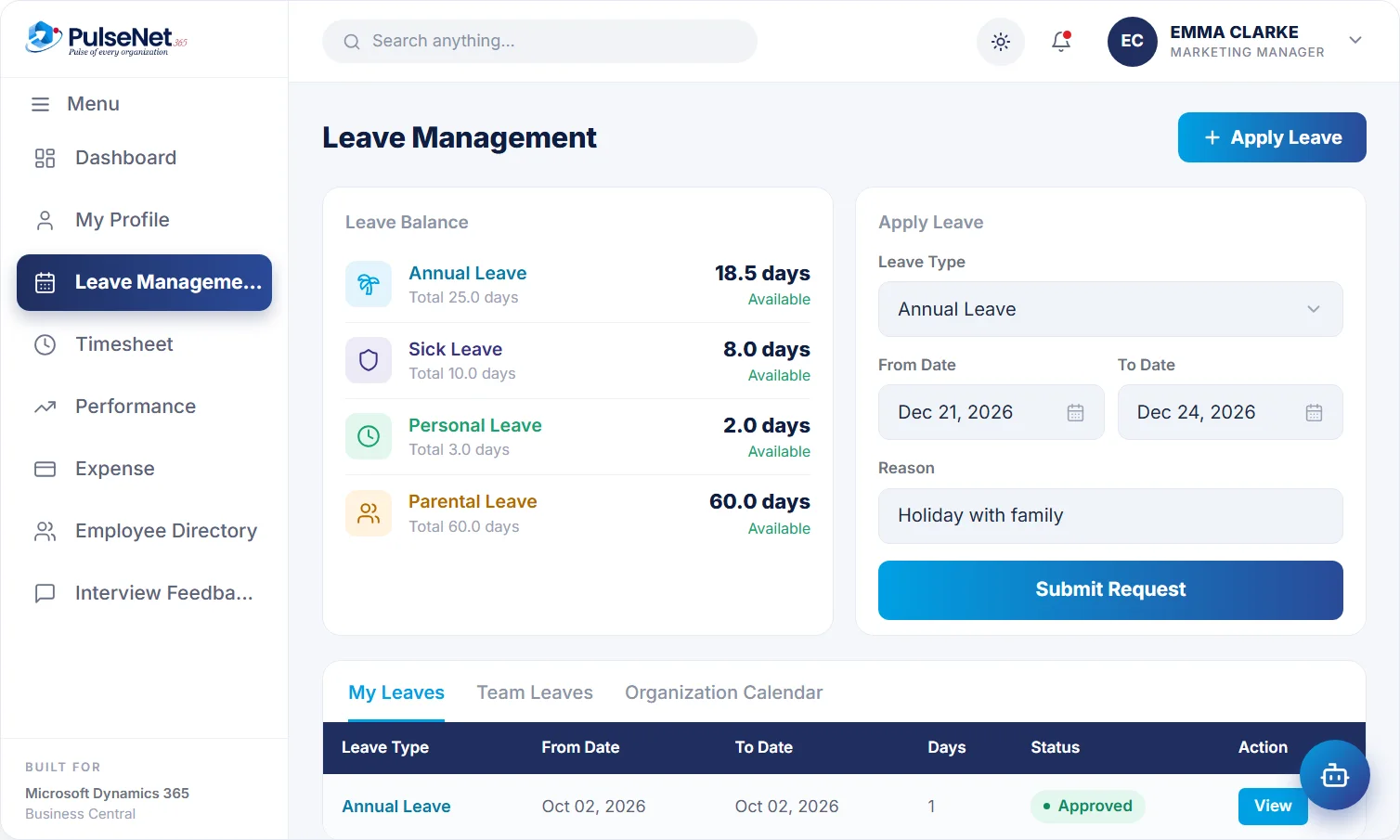
Employees see their balances and apply in seconds. Requests route to the right manager automatically, with team leave and the organisation calendar in view.
- Built for Business Central
- One employee record
Leave & Absence. Illustrative screen with sample data.
Leave approved
Dec 21–24
Balance 18.5 days
updated instantly
No team overlap
checked at approval
THE PROBLEM
Why nobody trusts the leave spreadsheet
Leave looks simple until you count the rules. Annual leave accrues monthly for some staff and is granted up front for others. Carry-over is capped, except for people returning from parental leave. Part-timers are pro-rated. Each rule lives in someone’s head or a spreadsheet formula, so every balance question becomes an email to HR, and every answer depends on who happens to reply.
Managers approve blind. They cannot see who else is off that week, so two people from a five-person team end up away at once. Then payroll hears about unpaid leave after the cut-off, and the correction lands in the following month’s pay.

WHAT GOES WRONG TODAY
- Balances that differ between the spreadsheet, the manager and the employee.
- Approvals given by email without any sight of team overlap.
- Carry-over and encashment decided case by case at the end of the year.
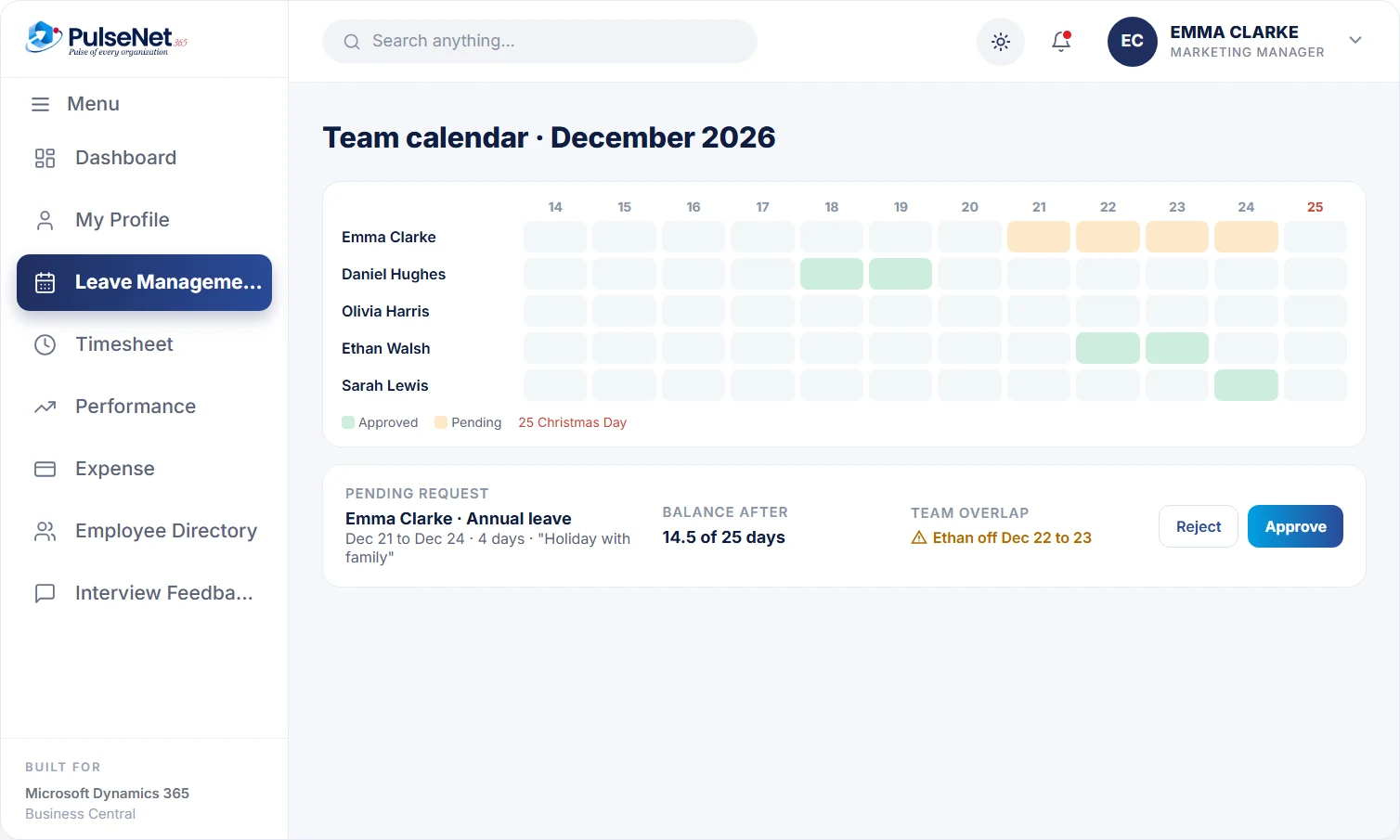
Team calendar with a pending request. Illustrative screen with sample data.
WHAT IT DOES
Built for the way leave and absence actually runs.
- Live balances for every leave type
- Apply in seconds, on web or mobile
- Approvals route to the right manager automatically
- Team leave and the organisation calendar in one view
- Approved leave ready for payroll integration
01
Employee applies
Leave type, dates and reason in one short form.
02
Manager approves
With the team calendar and balance in view.
03
Balance updates
Everyone sees the same number, instantly.
04
Payroll-ready
Approved absence is ready for payroll.
IN DETAIL
Leave rules written once and applied every time
HR encodes the policy, employees apply against it, managers decide with the facts in front of them, and the balance and timesheet update themselves.
Leave types with real rules
HR defines each leave type, such as annual, sick, casual or earned leave, with its own accrual, carry-over, encashment and eligibility rules. Types are assigned to employee groups by department, role or seniority, so a new policy for one group does not mean editing individual balances. Each rule is applied the same way for everyone it covers.
Requests in self-service or chat
Employees choose a leave type, dates and a reason in Self-Service , or simply ask the AI assistant in plain language. The assistant checks the balance before the request goes in, so people do not book leave they do not have. Either way, the request routes to the right manager for a decision, with the reason attached.
Decisions with team overlap in view
The manager sees the employee’s balance and who else in the team is off over the same dates before approving, or rejecting with a remark. That is the information managers used to ask for by email, and without it approvals are either slow or careless. A rejection carries its reason, so the employee knows what to change.
One approval updates everything
When leave is approved, PulseNet365 creates the matching timesheet entry and updates the balance straight away. The employee sees the new balance, the timesheet already shows the absence, and approved leave is ready for payroll integration. Nobody reconciles the leave calendar against timesheets at month end, because the two records were never allowed to disagree in the first place.
WHO IT HELPS
Leave from four points of view
Employees
See a balance for every leave type they are entitled to, apply in a short form or by asking the assistant, and get a decision with a reason. Upcoming holidays are on their dashboard, so people can plan around them before booking.
Managers
Approve or reject with the balance and team overlap in view, and add a remark when the answer is no. Upcoming absence for the team is visible in one place, which makes rota planning and the summer holiday season far easier than a shared calendar.
HR
Sets leave types and rules once, assigns them by employee group, and stops answering balance questions by email. Year-end carry-over and encashment follow rules already written down, which means fewer exceptions to argue over and a clear record when an employee disputes a balance.
Payroll
Receives approved absence as part of the payroll-ready data prepared for the provider. Because approval updates the timesheet too, hours and absence already agree before the period closes, rather than being matched line by line after the payroll cut-off has passed.
ON BUSINESS CENTRAL
Absence registration versus leave management
Business Central includes absence registration: HR records that an employee was absent, against a cause of absence such as holiday or sickness, and can review absence by cause over a period. It records what happened. It does not hold entitlement rules, calculate balances, take requests from employees or route them for approval. PulseNet365 adds that layer on the same employee record, and because approved leave also creates a timesheet entry, leave and time data agree without anyone reconciling them afterwards.
Business Central provides
- Causes of absence, such as holiday or sickness, set up by HR
- Absence registration for each employee, entered by HR
- Absence overviews by cause and by period
PulseNet365 adds
+
Accrual, carry-over, encashment and eligibility rules by employee group
+
Employee requests through self-service or the AI assistant
+
Manager approval with balance and team overlap in view
+
Automatic timesheet entry and balance update on approval
GOOD PRACTICE
What a workable leave policy looks like
Write the edge cases down
Most leave disputes come from cases the policy never mentioned: joining mid-year, moving from part-time to full-time, leave that spans a public holiday. Decide each one in writing before you configure anything. A rule you can explain in one sentence is a rule a system can apply.
Arrange approval cover in advance
Decide who approves when a manager is away, and make arranging cover part of booking the manager’s own leave. Requests routed to someone who is on holiday are a common reason leave approvals sit untouched for a week.
Announce carry-over limits early
If unused leave is capped or lost at year end, tell people in the autumn, not in December, and show each employee their balance against the cap. Early notice spreads leave across the year instead of emptying the office in the final fortnight.
QUESTIONS
Leave & Absence questions, answered.
Can different groups have different leave rules?
Yes. Each leave type has its own accrual, carry-over, encashment and eligibility rules, and types are assigned to employee groups by department, role or seniority. A different entitlement for the warehouse, or extra days after long service, is set up as a rule rather than adjusted by hand each year.
What does the manager see when approving?
The request, with leave type, dates and reason, the employee’s current balance for that leave type, and any overlap with teammates who are already off on those dates. The manager approves or rejects with a remark and the employee is told the outcome. The decision stays on the employee record.
What happens to timesheets when leave is approved?
PulseNet365 creates the matching timesheet entry automatically and updates the leave balance at the same time. The employee does not record the absence twice, and a timesheet can no longer show a full working day when the person was on approved holiday. See Time and Attendance for how approved hours are handled.
Can employees book leave through the AI assistant?
Yes. An employee can ask for time off in plain language, for example next Friday, and the assistant creates the request after checking the balance. The request then goes to the manager like any other. The assistant never approves leave; managers and HR do. See AI for HR .
Does PulseNet365 calculate holiday pay?
No. PulseNet365 prepares approved leave, together with approved hours and expenses, for your payroll provider through payroll integration . Your payroll provider calculates pay, including holiday pay and any deduction for unpaid leave, and remains responsible for filing payroll taxes on your behalf.
WORKS WITH
Connected modules.
Every module shares the same employee record on Business Central, so adding another one adds no integration work.
Time & Attendance
Track hours, shifts and overtime.
Self-Service
Everything employees and managers need.
Compensation & Payroll
Payroll-ready data, no re-keying.
+
+
+
+
Thirty minutes is enough to know if this fits.
Bring your Business Central setup and the process that costs you the most time. We will show you Leave & Absence on the platform you already run.