TWELVE MODULES
Buy the part that hurts. Add the rest later.
Twelve modules on one employee record, built for Microsoft Dynamics 365 Business Central. Start with the ones that cost you the most time, prove the case, then extend.
- Built for Business Central
- One employee record
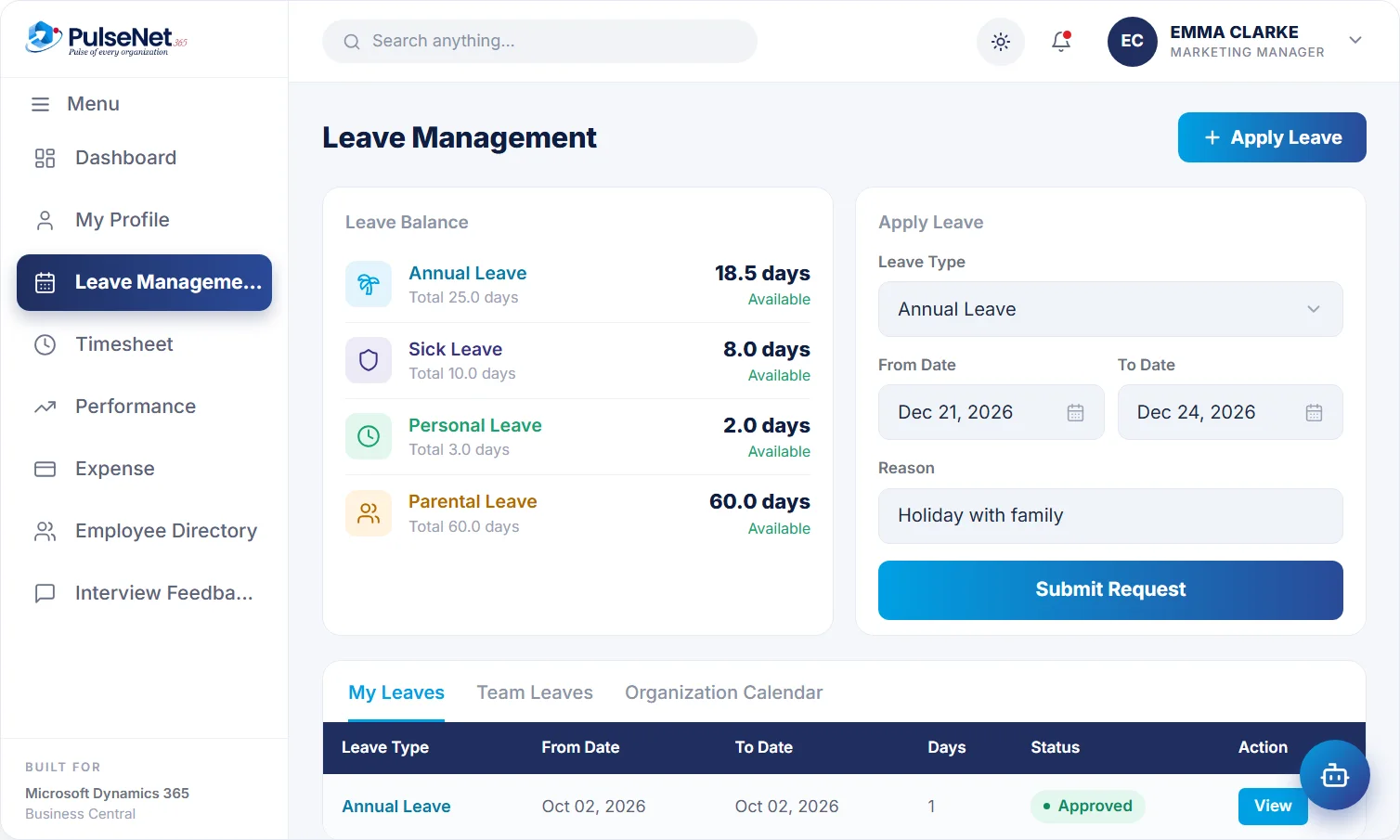
Leave & Absence. Illustrative screen with sample data.
THE MODULES
The whole employee lifecycle, in one place.
Hire and welcome
Requisitions approved in Business Central, roles published, candidates tracked, and new starters ready on day one.
- Recruitment: requisition to signed offer
- Onboarding: checklists with named owners
Hire and welcome
Requisitions approved in Business Central, roles published, candidates tracked, and new starters ready on day one.
- Recruitment: requisition to signed offer
- Onboarding: checklists with named owners
Hire and welcome
Requisitions approved in Business Central, roles published, candidates tracked, and new starters ready on day one.
- Recruitment: requisition to signed offer
- Onboarding: checklists with named owners
Hire and welcome
Requisitions approved in Business Central, roles published, candidates tracked, and new starters ready on day one.
- Recruitment: requisition to signed offer
- Onboarding: checklists with named owners
Hire and welcome
Requisitions approved in Business Central, roles published, candidates tracked, and new starters ready on day one.
- Recruitment: requisition to signed offer
- Onboarding: checklists with named owners
WHY ONE RECORD MATTERS
The modules are not integrated. They are the same record.
Because every module writes to the same employee on Business Central, an approval is the last time anyone touches the data. Nothing is exported, re-typed or reconciled afterwards.
- An accepted candidate becomes an employee, with no re-entry
- Approved leave and hours are ready for payroll
- Approved expenses reach finance
- A leaver's tasks all start from one date
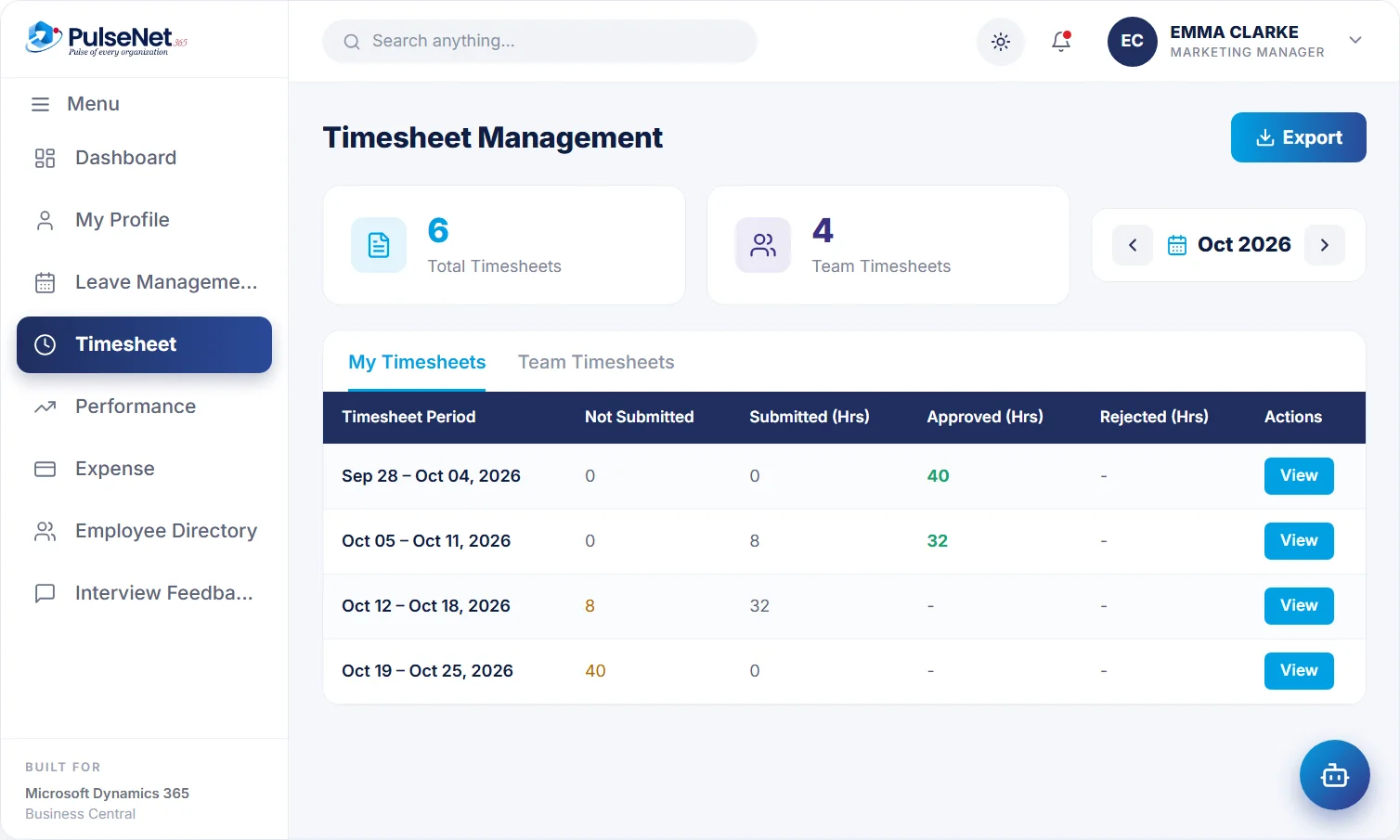
Timesheets by week. Illustrative screen with sample data.
WHERE TO START
You do not switch twelve modules on at once.
Leave and self-service
Leave is where the arguments are. A balance people trust produces a visible win quickly.
Time and leave
If billable time drives revenue, timesheets are a finance system. Leave comes with it.
Recruitment and onboarding
Hiring faster than the process can carry? Start at the front so every later module inherits clean data.
CHOOSING
Four questions that pick your first module
STEP 01
Where do people complain most?
Sort a week of HR emails by topic. If most are about balances and requests, Leave & Absence with Self-Service is the natural start.
STEP 02
Which process touches money?
If billable hours drive revenue or expense claims pile up at month-end, Time & Attendance or Travel & Expense shows value to finance first.
STEP 03
What is coming on the calendar?
A hiring push next quarter argues for Recruitment and Onboarding now. A review cycle about to start argues for Performance & Talent.
STEP 04
Is the employee data clean?
Every module relies on reporting lines and job details. If those are messy, begin with the Digital Personnel File so later modules inherit clean data.
OUTCOMES
What each module changes: hiring and everyday HR
Recruitment
Requisitions approved in workflow, applications recorded automatically, and the hire converted to an employee.
Onboarding
Every first-week task has a named owner and a due date, so new starters arrive to access and a plan.
Digital Personnel File
One record holds personal and job details, documents and policy acknowledgements, visible by role.
Leave & Absence
Policies set once by employee group, balances everyone trusts, and approval that updates the timesheet.
Time & Attendance
Timesheets submitted by period, approved or rejected with comments, and locked once approved.
Self-Service
Employees see balances, pending actions, holidays and the directory in one place, without emailing HR.
OUTCOMES
What each module changes: growth, pay and exit
Performance & Talent
Reviews built from templates, feedback locked before the meeting, and conclusions published on time.
Training & eLearning
Courses assigned by team or role, with exams, certificates and a training history on each record.
Travel & Expense
A receipt photo becomes a claim, the manager approves, and the approved claim reaches finance.
Compensation & Payroll
Approved hours, leave and expenses prepared for your payroll provider, which still calculates pay.
Help Desk
HR and IT questions become tickets with an owner, a category and a status through to resolution.
Offboarding
One leaving date raises access removal, asset return, handover and final pay details, each tracked.
MODULES FAQ
Module questions to settle before you choose
How do the modules share data?
They do not pass data to each other; they read and write the same employee record on Business Central. The hired candidate is the employee onboarding starts from, approved leave creates the timesheet entry, and one leaving date starts every offboarding task.
Does adding a module later mean a new project?
It means configuration and training for that module, not integration work. Your employee records and roles are already in place, so the new module starts from them. We quote any addition in writing first.
Which modules work best together?
You never need all twelve to start. Some pair naturally: Leave & Absence with Time & Attendance, because approval creates the timesheet entry; Recruitment with Onboarding, because the hire becomes the new starter; and Compensation & Payroll once leave, time and expenses are live.

Should each module have its own owner?
Yes, and it helps. Name one owner in HR for each module who agrees its rules, answers the first questions from managers and decides when the old spreadsheet can finally be retired.
+
+
+
+
Thirty minutes is enough to know if this fits.
Bring your Business Central setup and the process that costs you the most time.